

By LEAD — AI Training Academy · Updated 7 July 2026 · 7 min read
Vibe coding lets you build real software — apps, websites, dashboards, internal tools — by describing what you want in plain English and letting AI write the code. You don’t need a computer science degree or years of practice. If you can explain an idea clearly, you can build it. This guide explains what vibe coding is, how it works, the tools involved, and where Malaysian professionals can learn it properly.
What is vibe coding, exactly?
Vibe coding is a way of building software where you tell an AI what you want and it generates the working code for you. Instead of memorising programming syntax, you focus on the idea (the “vibe”) and guide the AI toward the result. The term was popularised in 2025 and has since exploded: searches for “vibe coding” have grown by thousands of percent, and it is now estimated to be a multi-billion-dollar category.
The most important thing to understand: vibe coding is not “coding made slightly easier.” It is a genuinely different workflow. You describe, the AI builds, you review and refine — a conversation, not a lecture. Roughly two-thirds of people using vibe coding tools today are not professional developers. They are founders, marketers, analysts, operations staff, and business owners building the tools they always wished existed.
In one line: Vibe coding = you supply the ideas and instructions in plain language; AI supplies the code. Your job is to think clearly and describe precisely.
How does vibe coding work?
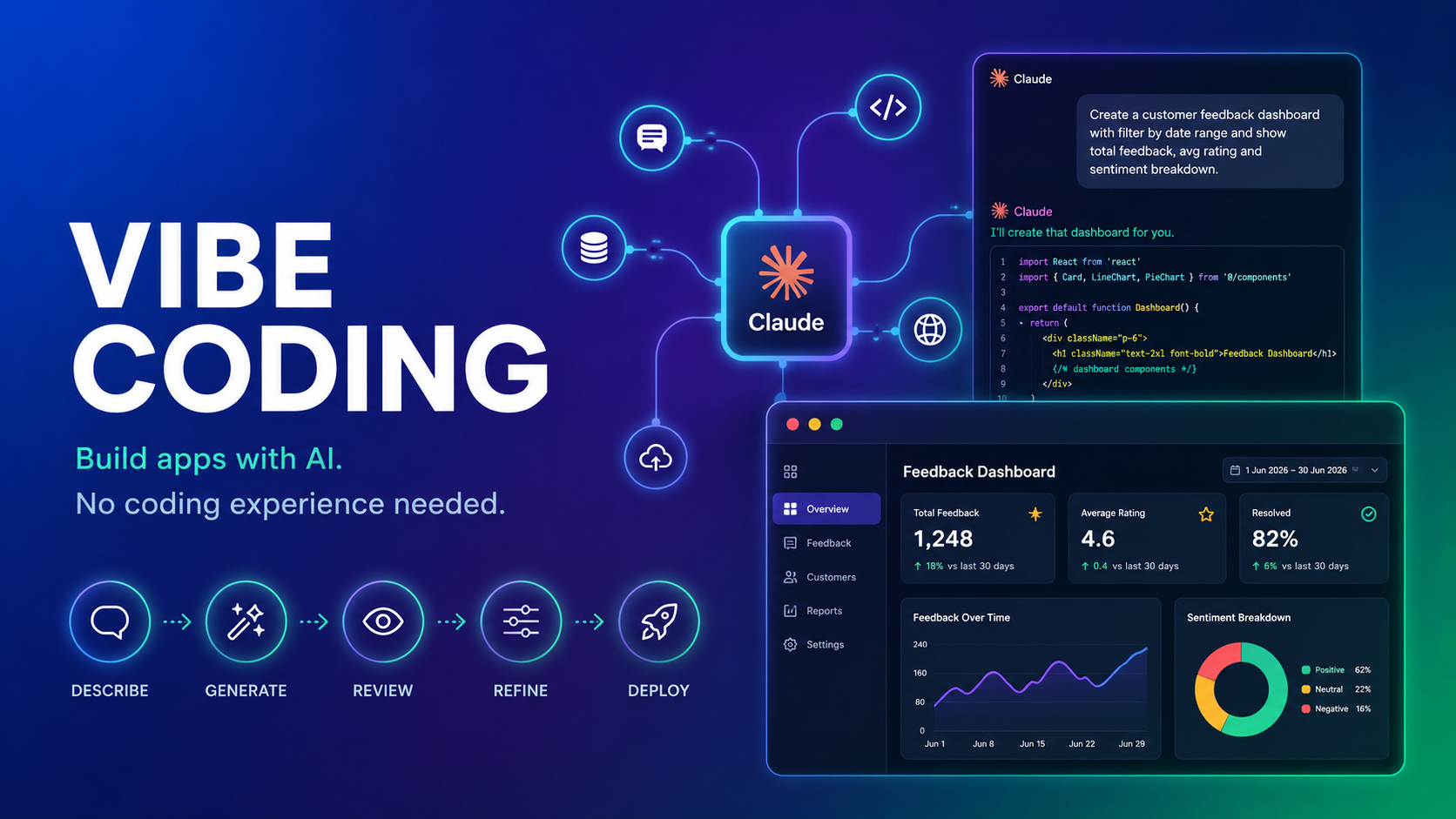
The basic loop is simple and repeats until your app is done:
- Describe — You tell the AI what you want to build (“a booking form that emails me when someone submits it”).
- Generate — The AI writes the code and often shows you a live preview.
- Review — You look at the result and spot what’s wrong or missing.
- Refine — You give feedback in plain English (“make the button yellow, add a phone number field”) and the AI updates it.
- Deploy — Once it works, you publish it so real people can use it.
The skill that matters is not typing code — it is describing what you want clearly and knowing when the output is correct. That is why vibe coding is learnable in days, not years.
What can you actually build with vibe coding?
More than most people expect. Common projects our learners in Malaysia build include:
- Internal dashboards that pull together data from different systems
- Customer-facing websites and landing pages
- Booking, registration, and enquiry forms with automated follow-ups
- Simple mobile-friendly web apps for a team or a business
- Prototypes to test a product idea before spending money on developers
Best vibe coding tools in 2026
| Tool | Best for | Level |
|---|---|---|
| Cursor | Building real, deployable full-stack apps | Beginner → Pro |
| Replit | Learning and quick browser-based projects | Beginner |
| Lovable | Fast web apps and prototypes | Beginner |
| Claude | Reasoning through logic and generating code | All levels |
| GitHub Copilot | Assisting people who already code | Intermediate |
Tools change fast. The durable skill is the workflow — describing, reviewing, refining — which transfers across whatever tool becomes popular next. That is what a good course teaches, rather than just clicking through one app.
Vibe coding vs traditional coding
| Traditional coding | Vibe coding | |
|---|---|---|
| Time to learn | Months to years | Days |
| You need to | Memorise syntax & logic | Describe ideas clearly |
| Speed to build | Slow, manual | Fast, AI-assisted |
| Best for | Complex, large systems | Apps, tools, prototypes, MVPs |
Vibe coding does not replace professional engineers for large, mission-critical systems. But for the everyday tools businesses actually need, it is faster, cheaper, and finally within reach of non-technical people.
Where to learn vibe coding in Malaysia
You can experiment on your own, but most people hit a wall — the app half-works, breaks, and they don’t know why. Structured training gets you past that wall fast. LEAD’s AI Vibe Coding Certification is a hands-on, 2-day programme in Kuala Lumpur that takes you from idea to a deployed, working application — with no prior coding experience required.
Because LEAD is registered with HRD Corp, the programme is HRDC-claimable: eligible Malaysian employers can cover 100% of the fee through their training levy. It is the same certification that has helped professionals at companies like Shopee, Maybank, and Axiata build tools they now use every day.
Learn to build with AI in 2 days — HRDC-claimable, hands-on, Kuala Lumpur. Go from idea to deployed app. → Explore the Vibe Coding Certification
Frequently asked questions
Is vibe coding suitable for people with no coding background?
Yes. Vibe coding was designed for non-programmers. You describe what you want in plain English and AI generates the code. Around 63% of people using vibe coding tools today are not developers.
Where can I learn vibe coding in Malaysia?
LEAD runs a 2-day AI Vibe Coding Certification in Kuala Lumpur that takes you from idea to a deployed app. It is HRDC-claimable, so your company’s training levy can cover the full fee.
Is vibe coding training HRDC-claimable?
Yes. LEAD’s AI Vibe Coding Certification is registered with HRD Corp, so eligible Malaysian employers can claim 100% of the programme fee through their HRDC levy under the SBL-Khas scheme.
What tools are used for vibe coding?
Common vibe coding tools include Cursor, Replit, Lovable, Claude, and GitHub Copilot. LEAD’s certification focuses on production-grade tools like Cursor so you can build real, deployable full-stack applications.
Is vibe coding just a passing trend?
The data suggests otherwise. AI now writes a large share of new code, adoption is near-universal among developers, and analysts expect AI-assisted building to make up a growing part of all software creation through 2027 and beyond. The tools will keep changing, but building software by describing intent is here to stay.
The bottom line
Vibe coding removes the biggest barrier that stopped non-technical people from building software: syntax. If you can describe an idea clearly, you can now build it. For Malaysian professionals and businesses, that means faster prototypes, cheaper internal tools, and a real edge over competitors still waiting on developer queues. The fastest way to get there is structured, hands-on training — and it is claimable through HRDC.
0 Comments